

Standard Weapon Notes
- back sword
- a single-edged sword, of proportions similar to its two-edged counterparts (as opposed to the falchion which is generally heavier)
- broad sword
- a sword with parallel edges and a relatively blunt point, of moderate length, used mostly as a hacking weapon
- falchion
- a single-edged sword, often with a curved blade and straight back.
- great falchion
- a larger falchion for hand-and-a-half or two-hand use.
- great sword
- an exceptionally large sword, exclusively for two-hand use, often with a secondary cross-guard protecting a ricasso.
- leaf sword
- a short sword with a waisted design, broad blade and stabbing point
- long sword
- a true sword of greater length, designed for hand-and-a-half or two-hand use
- rondel dagger
- a dagger with a sturdy triangular blade, used for stabbing with an overhand grip, and effective at penetrating mail
- sax
- a single-edged, heavy bladed knife or short sword similar to a bowie knife or machete
- true sword
- a sword with tapering edges and a sharp point, of moderate length, used for both cut and thrust
- war sword
- a longer broad sword, designed as a hand-and-a-half or two-hand weapon
Nami
Nami make mostly tools, so many of their weapons are obtained by trade with the Kingdom or the Salts (by way of the Morhirrim). Their one true sword is the leaf sword. They also make a utilitarian sax.

Nami weapons, as well as tools, are generally fitted with a grip of wood, either plain or carved. A hole bored through the grip accepts the tang, and a wooden ball forms the pommel. Nami weapons are also made of softer steel than most others.
The cross-section of the Nami leaf sword shows its flattened diamond shape, distinct from the star shape of the Asgansi leaf sword.
Kingdom
The Kingdom supplies many of the arms used in the weatherplain region. Their traditional sword was the strictly cutting broadsword, with a wheel pommel and straight crossguard ending in slightly flared or balled tips. Typically they use a flattened oval cross-section and a broad, single fuller running 2/3 the length of the sword, or more.

Grips are typically leather or wrapped wire. Occassional grips are seen made of ivory or bone.
Recently, Kingdom arms makers have begun expanding their repertoire, adding cut-and-thrust swords and alternate pommels and guard-tips, such as the square pyramid here illustrated.
The Kingdom Great Sword is recognizable by the straight bars on the secondary guard, and the relatively simple design of the leather-wrapped ricasso.
Salts
The Salts are the most famous makers of arms and armor this side of the hollow hills. The distinctive styling and evocative names of their swords are the pride of any warrior.

Salts swords have three different styles of blade. The simple and elegant Ancient names become a little cumbersome in translation, so "Willow-leaf-bending-in-the-wind" is usually glossed as "willow sword," "Serpentine-river-on-the-plateau" as "river sword," and "Rising-Crescent-Moon" as "moon sword." All of these swords are primarily cutting weapons, and they slice keenly, as opposed to the more standard kingdom sword which, in comparisom, seems to have an axe edge. The willow and river swords can be used in the thrust, while the moon sword, reversed, becomes a powerful piercing weapon against mail. All three have differentially tempered blades, resulting in a softer back that gives the blade spring, and a very hard edge—the reason for their keen sharpness.
The willow and river style blades can be proportioned for short, true, or long swords, and function the same in game terms. The moon sword functions as a true sword.
In the illustration, the willow sword has the most common guard: a hook on the front edge. The river sword has a "fan" guard, while the long willow sword has a "rose" guard.
The other distinctive Salts sword, the staff sword, is nearly always fitted with a willow-style blade.
Asgansi
Second only to the Salts in craftsmanship, the mysterious Asgansi work in a much more traditional style, making fine leaf swords. Even their long swords retain the leaf-shaped design. Asgansi blades are ornately engraved and decorated, unlike the simple, austere beauty of the Salts. The blades of their swords have an elegant star-shape section, as opposed to the simpler diamond section of the Nami leaf swords.
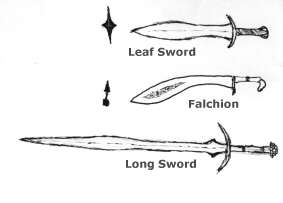
The other unique feature of Asgansi weapons is lace, here shown in the small falchion. Lace appears to be a cut-out hole in the center of the weapon, filled with an intricate design of knotted metal cords. In fact the weapon is made whole, and the design carved into the metal. Lace serves the same purpose as a fuller, lightening the blade without reducting strength.
Pommels are often of flower motifs, the lily shown on the leaf sword, the blooming rose on the long sword. The falchion shows the other popular pommel, animal heads, here a snake.
Irdling
The Irdlings, after the Kingdom, are second in volume of sword manufacture, but their designs are considered more fashionable, even in the Kingdom. Here is shown three styles of blade, the first a flattened oval with a fuller which is narrower and shorter than Kingdom varieties. The second is the diamond blade, which makes a strong thrusting sword, but one that is weak in the cut. The third shows the flamberge blade, the pride of the swordmaker's art.
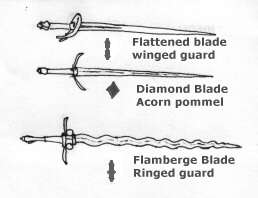
Guards are more involved than their kingdom counterparts, the simplest having a single ring on the side to prevent injury to the back of the hand. More ornate ones have several rings at cross angles for more elaborate protection. Quite recently, swordsmiths have begun making the wing guard, in which a pair of upraised wings protects the hand all about.
The diamond blade here illustrated shows the traditional acorn pommel. The flattened blade shows the popular garlic pommel.
